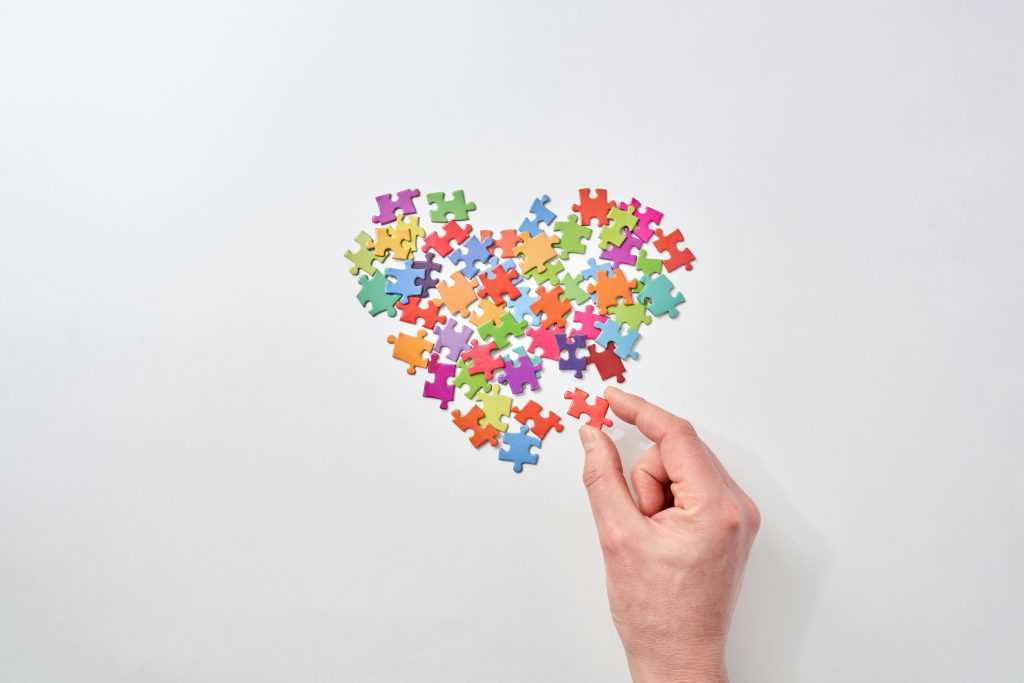
Dating men is like putting together a jigsaw puzzle.
You find the pieces. You establish the boundaries. You fill in the gaps. And sometimes, when it’s finished, you realize the picture on the box was never quite the life you actually wanted.
What people don’t talk about honestly is this: not every relationship has to last forever to matter. Some teach you something true about yourself. Some sharpen your boundaries until they’re actually useful. Some show you — clearly, finally — what you will not accept. And some become the kind of picture you frame and hang somewhere you can see it, because it became part of your story whether it lasted or not.
As a physically disabled woman, I’ve learned that dating carries an extra layer most people never have to think about.
Sometimes we are the unusual puzzle.
Not broken. Not incomplete. Not defective. Just unfamiliar.
Growing up, my disability never entered my mind as something that defined me. I wasn’t walking around thinking of myself as different. I was too busy being me. It wasn’t until college that I started noticing — slowly, then all at once — that some people saw me as a puzzle they weren’t sure how to approach.
I’ll give you two examples from the same year.
A guy I’d known since junior high picked me up for a date. He put the wheelchair in the trunk following my verbal instructions, we went out, we had a completely regular evening. The wheelchair was never mentioned again. It just… wasn’t the thing.
That same year, a guy from college asked me to dinner and a movie. I said sure. Then came the questions. How would he put the wheelchair away? Did I need help? Was there anything I needed to tell him before we went? By the time we actually got there, I was already exhausted. The date hadn’t even started.
Same wheelchair. Two entirely different puzzles.
And let me be very clear: unfamiliar does not mean undesirable.
I am not some dusty puzzle sitting on the clearance rack waiting to be pity-purchased. I am a fascinating, layered, worth-your-time puzzle. The men who are worth my time see that. They are curious. Interested. We reciprocate. And after years of doing this, I’ve gotten a lot better at spotting them early — the ones who pick up the box with genuine interest versus the ones who are already looking for the return policy.
But I also have to reckon with something honest: dating someone with a physical disability can feel genuinely unfamiliar to a non-disabled person at first. And suddenly the tables turn. They have to figure things out too.
They may not know where the boundaries are. They may not know how to ask questions without being offensive. They may not understand the difference between helping and overriding. They may have no framework for independence, accessibility, fatigue, pain — or for how much quiet damage society has already done to the disabled person sitting across from them at dinner.
In a world obsessed with flat rectangular puzzles, we are the 3D ones. We require a different kind of attention. A willingness to turn something over in your hands before assuming you know how it fits.
And here’s what puzzle lovers understand that casual assemblers don’t: the unusual ones are almost always the most memorable.
But none of that matters without the edge pieces. Boundaries are what make the whole thing possible. Without them, people start forcing pieces where they don’t belong. Someone becomes resentful. The other becomes exhausted. Nobody remembers why they started building in the first place.
For disabled women, this plays out in dating more than people want to admit. Some of us go quiet because we don’t want to seem difficult. Some of us shrink our needs because we’ve already been made to feel like too much work. Some non-disabled partners overhelp, infantilize, or quietly treat disability as helplessness — not out of malice, but out of assumptions nobody ever asked them to examine.
Both people end up frustrated because nobody laid down the frame first.
The other thing I’ve learned — and I mean really learned, the hard way — is that it is not your job to manufacture the missing pieces.
You cannot create emotional maturity, honesty, or readiness inside another person just because you care about them. Some puzzles cannot be completed no matter how badly you want them to work. And that’s not a failure. That’s just what’s true.
I never had a problem with becoming a mother. What I knew was that I didn’t want to be pregnant. Adoption has always been on the table for me — more than on the table. So if a man is fixed on the idea that it has to be his blood, that it has to happen a specific way, then the relationship is over before it begins. Not because either of us is wrong. But because the final picture is never going to match, no matter how much we both want it to.
People say dating is too complicated. Of course it is. So are puzzles. Some take patience. Some require stepping away and coming back with fresh eyes. Some turn out to be more advanced than the box suggested.
The difference now is that I know what I’m looking for. I know which puzzles are worth my time and which ones I can admire from across the room without touching. That’s not giving up on dating. That’s just getting good at it.
The puzzles worth keeping aren’t always the ones you finish. Sometimes they’re the ones that taught you what picture you were actually trying to build.
What’s your experience? Let me know in the comment section.
Be sure you’ve subscribed to my weekly newsletter. Click here.
After you’ve finished all 600 plus articles on this site, you can find yourself craving more. Here is my Substack account. Click here.
Believe it or note, I drink coffee. It’s also a great way to say, “Thanks, Nathasha for your work!” Buy me a coffee link is here. COFFEE