
For more than 10 years, Georgena Moran couldn’t independently open the back door of her home.
That matters because Georgena loves nature.
Outside that door are her plants, flowers, a giant Redwood tree and, within eyesight, a heavily forested park. Georgena uses a chin-drive power wheelchair and is paralyzed from the shoulders down. She could get to the door. Opening it was another story.
Then a robot came to visit.
When Vy Nguyen of Hello Robot brought Stretch to Georgena’s home and asked what she would like the robot to do, Georgena knew immediately.
If Stretch could open that back door and allow her to get into her backyard greenspace, she told Vy, “this would be a dream come true.”
Vy worked with Georgena to adapt Stretch to work with the Tobii Dynavox eye-tracking technology Georgena already uses.
And then Georgena opened her door.
“For the first time in over 10 years, I used Stretch to open my back door independently, so I could go out onto my patio deck and enjoy my beautiful plants, flowers and giant Redwood tree in the center of my yard,” Georgena told AudacityMagazine.com. “To me, this is bliss!”
Not a robot doing a backflip nor performing some flashy trick designed to go viral.
A woman opened her back door.
And if you live with a physical disability, I probably don’t have to explain why that can be a very big deal.
Meet Stretch 4
Stretch 4 is a mobile robot developed by Hello Robot. The company describes it as an open-source robotics platform designed for researchers, developers and engineers working on what it calls Physical AI.
It has an omnidirectional mobile base, an extendable arm, cameras and sensors, interchangeable tools and a computer system that allows developers to create ways for the robot to interact with people and objects.
But I’m less interested in listing everything Stretch has inside of it than I am in what someone can actually do with it.
And so is Vy.
Vy is an occupational therapist at Hello Robot, and she approaches the technology from that perspective.
“Before introducing any technology, we take the time to understand who they are, their environment, and their functional abilities,” Vy told me, including a person’s physical, socio-emotional and cognitive needs.
That distinction matters.
Disabled people have seen plenty of products supposedly designed to help us without anyone apparently asking us whether we wanted the help, whether we could use the product or whether it solved a problem we actually had.
Vy even has a word for that approach: “solutioneering.”
Her preferred philosophy is much simpler:
“Design with, not for.”
Disabled People Aren’t Just Testing the Finished Product
I wanted to know exactly how early disabled people enter Hello Robot’s development process.
Not after the robot is finished nor when it’s time to make a promotional video.
During the actual work.
Vy gave me a concrete example.
In 2021, while completing her occupational therapy doctoral capstone, she worked with Hello Robot and Henry Evans, a nonspeaking self-advocate with quadriplegia.
Over four weeks, the team repeatedly modified interfaces based on Evans’ feedback. One addition was a camera mounted on Stretch’s gripper so Evans could see what the robot was picking up. Fisheye cameras also helped him see when the robot traveled outside his direct line of sight.
Today, according to Vy, a gripper camera comes standard on every Stretch robot.
Georgena influenced the technology too.
Because she controls her computer using eye tracking, the existing interface presented problems. She couldn’t simply use it the way someone operating a conventional mouse or touchscreen might.
Vy said Georgena provided feedback about such details as whether icons were legible and whether particular buttons were difficult to target with her gaze. The team then made adjustments to the interface.
Georgena experienced that process from the other side.
“The keyboard doesn’t allow me to ‘dwell’ in one place,” she explained. That initially made operating Stretch difficult.
Vy had to find another way. She did. And Georgena opened that door.
That’s what accessibility development looks like when it gets very specific. Sometimes the difference between “accessible” and “I can’t use this” is one button you can’t target.
But Stretch Doesn’t Live With Georgena
This is an important distinction. Stretch does not live in Georgena’s home. It has been there once.
Most of Georgena’s experience with the robot has actually taken place elsewhere, professionally and recreationally. And that’s where her story becomes something I wasn’t expecting when I first started looking into Stretch.
Georgena conducts trainings around the country, but because travel can be difficult, she often participates remotely.
Before one local Summit, she happened to see an advertisement showing Stretch moving alongside someone while a tablet mounted on the robot displayed another person’s face.
Georgena had an idea. Could she use Stretch to participate in the Summit?
She contacted Hello Robot and, in one of those coincidences that sounds almost too convenient to be true, Vy lived in the same town and was available on the day of the event.
Georgena gave her large-screen presentation as usual. But then, through Stretch, she participated in small-group discussions, mingled at the after-party and even helped distribute branded cooling scarves.
She wasn’t simply watching the event remotely. She had a presence in the room.
Portland, Meet San Francisco
Then came an experience Georgena describes as beyond her “wildest independent dreams.”
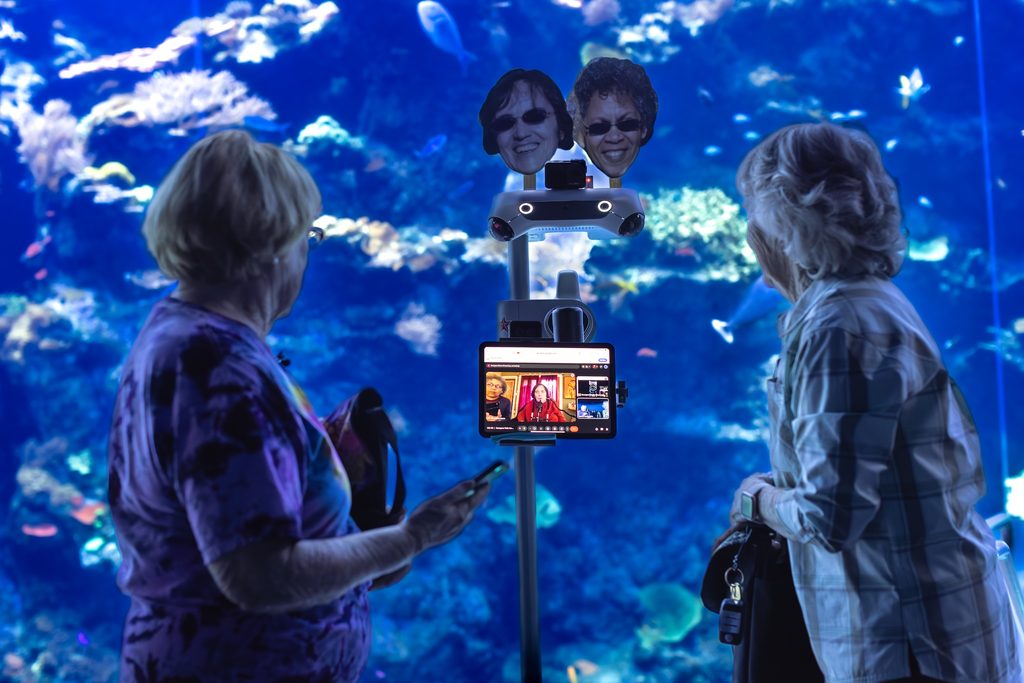
She was at home in Portland, Oregon. Stretch 4 was at the California Academy of Sciences in San Francisco. Vy and Dr. Vinitha Ranganeni, formerly of Hello Robot and now at Stanford, worked to make it possible for Georgena to remotely control Stretch using her eye-tracking technology.
According to Vy, the experience required weeks of preparation, accessibility work, coordination with the museum and multiple practice sessions. Georgena’s two sisters, who live in the Bay Area, joined her experience. Through Stretch, Georgena explored exhibits filled with jellyfish, coral reefs, colorful fish and sharks. And then a scuba diver challenged Georgena and Sharon, her partner, to rock-paper-scissors.
They lost. The diver celebrated by flipping upside down.
“Ha ha! Show off!” Georgena recalled.
That detail makes me smile because this is where the conversation about robotics becomes less about performing a task and more about participating in life.
Georgena believes robot designers need to think beyond the home.
“Encourage people to think outside the box,” she said.
If robots were available in different locations, she wonders whether they could create more opportunities for disabled people to travel remotely, attend events or spend time with people they love.
Vy is thinking about that possibility too. She told me she would like to see Stretch available in community spaces so disabled people could remotely visit museums, concerts, conferences and other places they might otherwise be unable to access.
No, that’s not the same thing as physically traveling somewhere. But that doesn’t mean it has no value. Those two truths can exist at the same time.
Sharon Was Watching Too
There’s another person in this story whose perspective matters.
Sharon is Georgena’s partner. When Stretch visited their home, she watched Georgena use it to open that back door.
“The moment that impacted me was when Georgena opened the backdoor with the use of Stretch,” Sharon told me. “It gave me much pleasure watching her be able to go outside independently. Especially, because of her love for the great outdoors.”
I think that matters.
Technology that changes what one person can do can also change the dynamics around the people who love them. But Georgena and Sharon aren’t telling every disabled person that a robot belongs in their home. Their answer was much more practical.
“It depends on what you want the robot to do, and if it increases your independence to a degree that is worthwhile,” they said.
For Georgena, independently going outdoors meets that test.
What Doesn’t Work?
I specifically asked Georgena what Stretch gets wrong. Because come on. If I’m going to tell you about a nearly $30,000 robot, we’re not skipping that part.
Her eye-tracking compatibility was one problem. The difficulty was eventually solved, but it required Vy to reconfigure how Georgena interacted with Stretch. There are also things Georgena would like Stretch to do that aren’t part of her current experience.
At the top of her wish list?
Grab a snack from the counter and bring it to her mouth. She would also like it to open and close windows. Those requests sound extraordinarily ordinary. That’s what makes them interesting.
“Grab the Cup” Isn’t So Simple
Vy explained that even tasks that look ridiculously simple to us can be incredibly complicated for a robot. Tell Stretch to grab a cup in one person’s house and engineers may be able to train it to do exactly that. Move it into somebody else’s house and the same task may not work. Different object. Different counter. Different room. Different person. Different preferences.
And there’s another question: How does the robot know how I want that cup brought to me?
Vy said creating autonomous behaviors that transfer reliably between different home environments requires substantial engineering and computing resources. But what she said next interested me even more. Some disabled users don’t want complete automation. They want shared control. They may want the robot to automate certain movements while retaining manual control over others.
Why?
Agency.
Vy pointed out that someone who already relies on another person for significant physical assistance may not necessarily gain the desired sense of control by replacing a person who does everything for them with a robot that does everything for them.
The goal is to let the individual determine when the robot assists and when the person remains in control.
Now we’re talking about something much more interesting than robotics. What does independence actually mean? Is independence simply accomplishing a task without another human being? Or does independence also mean having control over how that task gets accomplished?
I know which definition interests me more.
And Now We Need to Talk About $29,950
Stretch 4 costs $29,950 as a research and development platform. It is not currently available for individuals to purchase as a ready-to-use assistive product.
There it is.
Because we cannot spend all this time talking about independence without talking about who could afford to buy that independence.
According to Tim Smith of Element PR, who represents Hello Robot, the company is inviting selected users and care partners into remote testing, with a smaller number participating in intensive in-home co-design. Engineers and specialists such as Vy work with them to develop capabilities around activities that matter to each person. Hello Robot says its goal is for the next version of Stretch to be available for individual purchase. Smith says producing robots in greater numbers for home use could improve affordability, while the company continues exploring possible reimbursement pathways. That is the goal, not a product or price currently being offered to consumers.
I asked Georgena and Sharon what they thought about the price.
Their answer was short.
“Of the few people I know with quadriplegia, the price tag would be beyond their means.”
So I put the affordability question directly to Vy.
“Most individuals don’t have $30,000 lying around to drop on a robot,” she acknowledged.
Hello Robot is exploring possible ways to change that.
According to Vy, those discussions include private insurance, Medicare and Medicaid, veterans’ benefits through the VA, state Medicaid waivers and government subsidies.
She also mentioned the possibility of leasing or financing, giving an example of payments between $200 and $500 per month rather than requiring someone to come up with almost $30,000 at once.
But let’s make something very clear:
Hello Robot does not currently offer that financing option.
Vy said affordability strategies like that are being discussed. That’s an important difference between what might happen and what a disabled consumer can access today. And even $200 to $500 every month raises another conversation about affordability.
The technology can be brilliant. It can be life-changing. It can be designed alongside disabled people. But if the disabled people who need it can’t afford it, accessibility remains incomplete.
So Would Georgena Actually Want One?
After everything she’d experienced, I asked Georgena and Sharon the question I’d probably ask if I were reading this article: Would you actually want a robot like Stretch in your home?
Their answer wasn’t an automatic yes. It depends. Does it do something you actually want? Does it increase your independence enough to make it worthwhile?
For Georgena, there’s at least one answer she already knows.
A door. A backyard. Plants and flowers. A giant Redwood tree. And the ability to decide for herself when she wants to go outside.
There are still enormous questions surrounding technology like Stretch. What will these robots eventually be able to do reliably? How much control will disabled users retain? Will insurance ever recognize them as more than expensive technology? Can the price come down enough to make them realistic for ordinary disabled people?
Hello Robot doesn’t have all of those answers yet.
Neither do I.
But I keep coming back to something Georgena said.
“To me, this is bliss!”
She wasn’t talking about artificial intelligence, sensors, cameras, or robotics.
Georgena was talking about going outside. And maybe that’s where conversations about assistive technology should begin. Not with what the technology can do. With what we want to do.
Stay Audacious!
So, what would you have Stretch do for you? I already have a few ideas of my own, but I’m more interested in yours. Tell me in the comments because I have a feeling we could give those engineers a wish list that would keep them busy for years!
If you enjoyed this article, subscribe to the Audacious Newsletter. You’ll get more stories, opinions, and a little bit of my audacious attitude delivered straight to your inbox.
And if you appreciate the work I do to keep AudacityMagazine.com going, buy me a coffee. ☕ Running an independent magazine takes time, dedication, and yes, plenty of coffee! Every little bit helps, and I appreciate your support.
Until next time, keep asking questions, speaking your mind, and never apologize for being audacious!