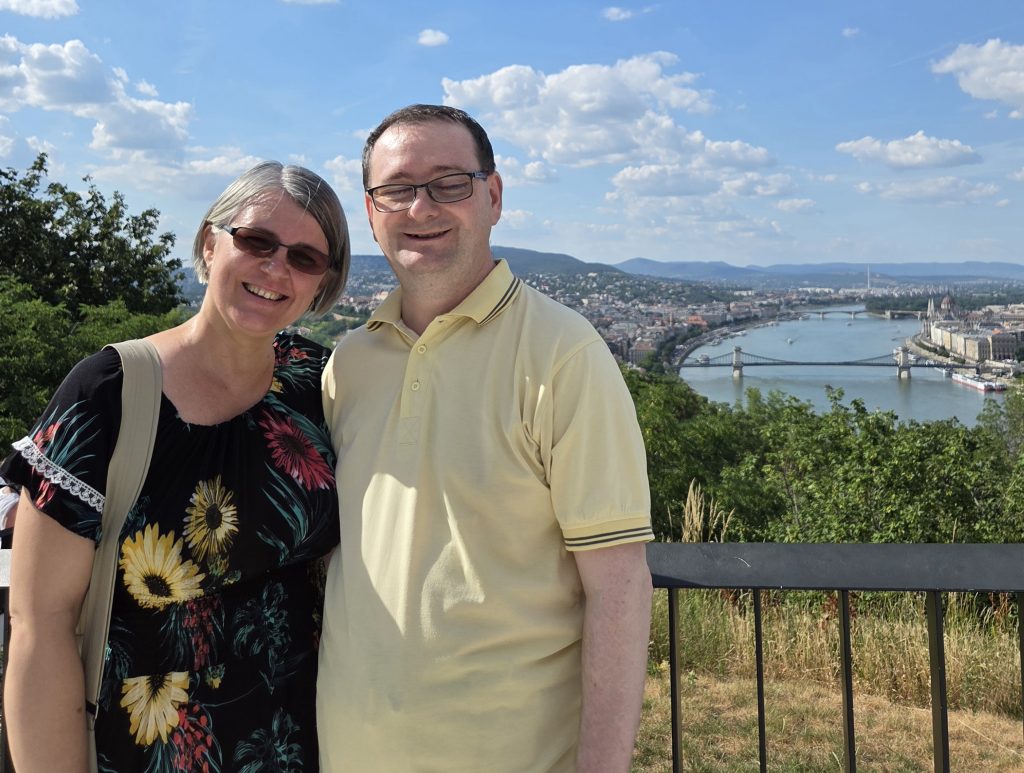
On December 3, 2009, the International Day of Persons with Disabilities, my wife, Alexa, and I founded a company in Hungary. I am visually impaired, and Alexa has a physical disability. We weren’t planning to sell medical aids. We wanted to change the way disabled people were spoken about and treated.
We had both seen disabled people presented too often as objects of pity and too rarely as adults, customers, employees, founders, or decision-makers. Our original company, FKI Nonprofit Ltd., focused on accessible communication and physical accessibility. We assessed websites, examined municipal buildings, advised organizations, won a few small contracts, and believed the social value of what we were doing would be obvious.
About six months later, the financial crisis taught us something considerably less idealistic: a worthwhile cause and a viable business are not the same thing.
We had almost no marketing budget and had invested our own savings. Eventually, we had to admit that the original model wasn’t going to support us. That was painful because when a cause matters deeply to you, it’s easy to assume someone will pay for the work because the work should exist. Unfortunately, good intentions don’t pay rent, buy stock, or create financial security.
We didn’t stop believing in accessibility. We simply had to find a way to make that belief useful in people’s everyday lives and sustainable enough for us to keep doing it.
People were already showing us where to look.
They began asking us to find things that were difficult to buy in Hungary: talking clocks, communication aids, visual schedules, specialist toys, tactile guidance strips, reflective products, and other assistive items. We tracked down suppliers and, because every forint mattered, sometimes collected the goods ourselves using public transportation. Products were stored among the furniture in our flat. Orders were packed in our living room and carried to the post office in shopping bags.
It wasn’t glamorous, and there was certainly no polished start-up story to tell. We were doing what we could afford to do, one order at a time.
As the requests grew, we noticed something important. People weren’t coming to us because they wanted to have an abstract conversation about accessibility or independence. They had something happening in their lives and needed a practical solution.
In 2011, we launched Értéksziget, which eventually developed into a medical aids shop, online retailer, and home-care knowledge center in Budapest. The business was very different from the one we had imagined two years earlier, but the question behind it wasn’t: Does this service actually work for the person who has to use it?
That question became more complicated than we expected.
At first, for example, we assumed that someone shopping online would simply place an order online. The website worked, but some older customers, blind and partially sighted people, and people who lacked confidence online became stuck during registration, payment, or delivery selection. They could find what they wanted and still be unable to buy it.
I know that frustration personally. I work with screen-magnification software, a programmable mouse, a high-visibility keyboard, and larger screens. These aren’t optional comforts for me. They’re what allow me to work independently and accurately. I notice quickly when a website is cluttered, poorly structured, or unnecessarily difficult to use.
But there’s another problem that even a technically accessible website can’t solve: a search box is only useful if you know what to type into it.
Real life doesn’t arrive in neat product categories. A family contacts us because a father keeps getting up at night and they’re afraid he will fall. Someone’s mother can no longer get into the bath safely. A husband is coming home from the hospital in a few days, and nobody has explained how the family will manage transfers, toileting, washing, or the other realities of caring for him at home. People don’t always know the name of the thing they’re looking for. Sometimes all they know is what has suddenly become difficult.
That’s one reason we introduced telephone ordering. Today, around ten percent of our orders come by phone. I don’t consider that an occasional favor or an exception to our system. It is one of the ways the system works.
Some people prefer ordering online. Others explain themselves better on the phone. Email works when someone needs to send measurements, photographs, or product numbers. And sometimes a person needs to come into the shop, feel the weight of something, compare its size, and find out whether they can actually operate it.
A fully automated store might be more efficient for us. It would also exclude some of the people we exist to serve.
Over the years, I’ve come to think that accessibility isn’t always about finding the one perfect solution. Sometimes it’s simply about making sure there is more than one workable route.
Listening to customers also taught us that helping someone doesn’t necessarily mean selling them something. A person may call knowing exactly what they intend to buy, but once we understand the situation, it becomes clear that the product may not solve their problem. We can make the sale anyway, or we can say so.
Sometimes we lose the sale.
If the situation requires clinical assessment or advice from another professional, we tell the person that too. Our job isn’t to diagnose people or overrule medical advice. It’s to ask the ordinary questions that can make the difference between something that is technically appropriate and something that will actually work in someone’s home.
A shower chair can meet the correct weight limit and still not fit through the bathroom door. A rollator can be stable but too wide for the hallway, too heavy to lift into a car, or have brakes the person can’t operate. Those aren’t minor details when you’re the person who has to live with the equipment after everyone else goes home.
I used to think good customer service meant always having an answer. Now I think certainty can be dangerous when the situation is unclear. An honest limit is sometimes more useful than a confident recommendation.
Eventually, we had to apply that same honesty to ourselves.
Alexa’s hand tremor and fine-motor difficulties mean she can’t safely pack orders. We could have organized the business around an idealized version of what she should be able to do. Instead, we divided responsibilities according to what each of us can do well and reliably. We automated processes, introduced barcode stock control, and chose tools that genuinely help us.
My visual impairment works the same way. Sometimes it helps me notice unusable design faster. Other times, it’s simply a disadvantage that requires more time, specialist equipment, money, or assistance.
I don’t describe disability as a superpower, and Alexa’s disability isn’t an inspirational device. Disability is a reality that our work has to accommodate.
A business cannot depend on permanent heroics. It cannot rely on people forcing themselves through tasks their bodies cannot do safely or fixing bad processes through willpower every day. The system has to remain workable when we’re tired, when one of us is having a worse day, or when something genuinely exceeds our physical capacity.
After more than fifteen years, that may be one of the most important things running this business has taught us.
Disabled founders are often pushed into one of two stories. We’re either pitied or turned into heroes. Neither role interests me. I don’t want people to expect less from us because we’re disabled, and I don’t want ordinary business decisions described as superhuman achievements.
I’d rather be judged on the same questions as any other business owner. Do we provide reliable products? Do we answer honestly? Do we keep our promises? When we make a mistake, do we accept responsibility?
Most of our customers don’t know that Értéksziget is run by two disabled founders. I consider that a good sign. They don’t buy from us out of sympathy. They come because they need something, trust the shop, or had a good experience before. A personal story may attract attention, but it can’t replace quality.
More than fifteen years after we began, I don’t see our story as one of overcoming disability. We haven’t overcome it. We live with it, work with it, and organize the business around our actual capacities. Sometimes disability gives us useful insight; sometimes it limits us.
What we have done is turn some of the barriers we’ve experienced into practical knowledge.
A failed accessibility consultancy became an online store packed in our living room. Shopping bags filled with parcels became a specialist shop, a multi-channel service, and a knowledge center. The original mission survived, just not in the form we expected.
Disability didn’t make us special. It made it impossible for us to ignore the gap between a system that works on paper and one that works for a real person.
After all these years, maybe that’s still the most useful accessibility question we know to ask:
It works. But for whom?
Author Bio: Zoltán József Szabó is visually impaired and the co-founder of Értéksziget in Hungary. Together with his wife, Alexa Szabó, who has a physical disability, he founded FKI Nonprofit Ltd. in 2009 and launched Értéksziget in 2011. Today, Értéksziget operates in Budapest as a medical aids shop, online retailer, and home-care knowledge center.
Keep the Conversation Going
Accessibility that works on paper isn’t always accessibility that works in real life. What’s one supposedly “accessible” system you’ve encountered that still left you out? We want to hear about it.
📬 Want more stories like this? Join the AudacityMagazine.com newsletter for disability lifestyle stories, conversations, giveaways, and more from our community.
Subscribe: audacitymagazine.com/subscribe
☕ Want to help keep the lights on? AudacityMagazine.com has been amplifying the voices and experiences of people with physical disabilities since 2003. If you enjoy what we do, you can support the magazine through Buy Me a Coffee.
Support us: buymeacoffee.com/nathashaalvarez
Comments
The idea that accessibility is often about having more than one workable route, not one perfect solution, applies to communication aids too. A typing-based AAC app like TypeOut can suit someone who can read and write but can’t speak, while a person who relies on picture symbols needs a different kind of tool, and saying that plainly is more useful than pretending one recommendation fits everyone. Thank you for being upfront about where a product is not the right fit.