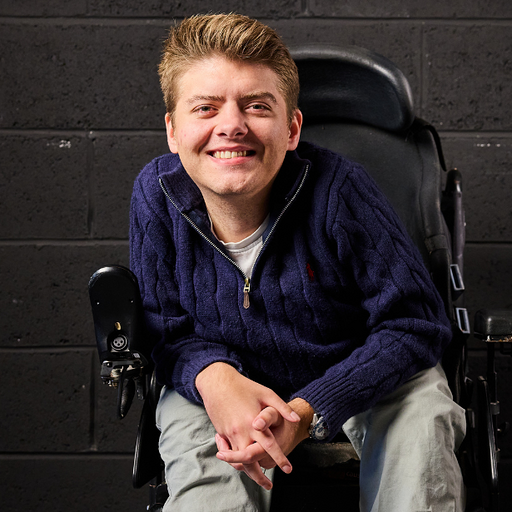
For powerchair user Sam Woodall, accepting a little help can feel like owing someone a favor. His story raises an uncomfortable question: When does independence become its own form of punishment?
A cup of tea. That’s all.
No elaborate request. No major disruption to anyone’s day. Someone offers to make a cup of tea, and most people either accept or decline depending on whether they fancy one.
For Sam Woodall, the decision can involve a mental negotiation worthy of an international peace treaty. He might want the tea. He might even be thirsty. But accepting means someone else has to make it for him. So he says no. Not because he doesn’t want it, but because he doesn’t want to be another item on someone’s to-do list.
“If I wasn’t disabled, I could just get up and make one myself,” Sam explains. “So asking somebody else evokes this feeling that I was giving them another job and inadvertently succumbing to weakness at the same time.”
Oh, Sam. It’s a cup of tea, not a mortgage application. Except I understand exactly why that cup comes with so much emotional baggage.
For many of us with physical disabilities, assistance can carry an invisible price tag. We calculate the inconvenience, consider the person’s mood, wonder whether we’ve already asked for too much, and occasionally decide we’d rather go without. The trouble begins when going without becomes a habit.
Mobility retailer Complete Care Shop has partnered with powerchair user Sam Woodall and HUB, a UK marketing and public relations agency, to raise awareness of what Sam calls the “burden of guilt.”When I reached out to Sam, I wanted to explore more than the familiar message that it’s okay to ask for help. His answers took me into the complicated territory of independence, pride, relationships, and the mental calculations that can turn something as ordinary as accepting a cup of tea into an emotional negotiation.
Sam calls it what it is.
“When you repeatedly deny yourself things because you don’t want to inconvenience somebody else, it starts becoming a form of self-punishment.”
And there it is. The moment when consideration for others quietly crosses the line into denying yourself things you want.
The Invisible Accounting Department
Sam has developed an extraordinary talent for keeping track of what other people do for him. Time spent helping. Plans adjusted. Favors granted. Effort expended. Nobody handed him a ledger, but somewhere in his mind, the accounting department never closes.
He admits that even when someone offers assistance willingly, he can struggle to accept it without feeling that he owes something in return.
“I don’t think I’ll ever be able to shift the idea of it being ‘transactional’ when it comes to people who don’t necessarily know me as well,” he says.
Then comes an admission that made me stop reading for a moment. He explains that this feeling motivates him to offer value in other areas, almost as though he must earn the assistance he receives. And immediately after writing that thought, he catches himself.
“Which, having just written down, sounds mental.”
There’s something wonderfully revealing about watching someone recognize the absurdity of an expectation while admitting he still lives by it. But the underlying question isn’t funny.
Why should someone feel obligated to compensate for needing physical assistance?
We don’t generally expect friends to maintain a running balance of every favor exchanged. Relationships involve giving, receiving, compromising, and occasionally doing something for someone simply because we care about them.
Yet disability can turn ordinary acts of kindness into complicated emotional transactions.
Sam isn’t accusing the people around him of keeping score. He’s the one holding the pencil.
When Independence Lands You in the Hospital
Sam’s determination to avoid relying on others followed him to university. He wanted the freedom to live independently, take risks, and experience student life without someone hovering over him. A perfectly reasonable ambition. His execution, however, left something to be desired.
Through what he describes as a combination of pride and stubbornness, Sam went without adequate care arrangements or a contingency plan for emergencies. He wasn’t eating enough. He was pushing himself. And one night, after drinking, he fell down four stairs at McDonald’s and ruptured his spleen. Somehow, he managed to get a bus home, drinking more along the way, before making it to bed.
The following morning brought severe abdominal pain and blood in his urine. He spent ten days in the hospital. If you’re waiting for me to applaud his determination, you may want to make yourself comfortable. Sam isn’t particularly interested in polishing the experience into a heroic tale either.
“University was probably the clearest example of me taking independence too far,” he admits.
He had wanted to prove he could manage on his own. Instead, the consequences placed enormous pressure on the very people he had been trying not to inconvenience.
That’s a cruel little irony.
His refusal to accept sufficient support didn’t eliminate the need for help. It contributed to a situation in which he needed far more of it. Still, Sam doesn’t regret wanting freedom.
He believes taking risks, making mistakes, and collecting experiences are essential parts of living. He doesn’t want disability to become an excuse for being sheltered from the world.
I agree with him there.
Disabled adults are entitled to make questionable decisions. We don’t lose that privilege because someone else thinks our lives should be managed with extra caution. But there’s a difference between choosing a risk and pretending the consequences don’t exist.
Sam learned that distinction the hard way.
The Sigh That Says Everything
Not all guilt comes from within. Sometimes it arrives courtesy of another person’s facial expression. A sigh. An eye roll. That look someone gives when you’ve interrupted their plans. Sam has encountered his share of unpleasant experiences, including with taxi drivers and public transport. He also describes something more subtle: being out with friends and needing to use the bathroom just as everyone has settled down with their drinks.
Suddenly, he’s apologizing.
“I’m really sorry fellas.”
It’s a familiar scene for anyone who has ever needed assistance at an inconvenient moment. The problem, of course, is that bodies don’t consult social calendars. Sam doesn’t believe the people closest to him are deliberately making him feel guilty. In fact, he describes having a strong support network that understands his needs and doesn’t expect apologies.
The guilt often appears without anyone saying a word.
“You can see somebody changing their plans, giving up their time or repeatedly doing things for you, and you start telling yourself that you’re a burden.”
Because noticing someone’s effort isn’t the same as being an inconvenience. And recognizing that assistance requires time doesn’t mean the person offering it resents you. Sam has begun questioning the stories he tells himself.
“Has this person actually indicated that helping me is a problem, or have I decided on their behalf that I’m a problem?”
Now that’s a question capable of starting an interesting argument around a dinner table.
How many times have we interpreted someone’s silence as frustration? Or declined an invitation because we assumed accommodating us would be too much trouble? Of course, sometimes people really are annoyed. Sometimes the sigh means exactly what we think it means. Sam isn’t suggesting we ignore that. He has learned not to invest too much in relationships with people who make his needs feel like an inconvenience.
“Relationships work both ways,” he says.
And that’s where his story becomes more interesting than a simple lesson about accepting assistance. He wants to be considerate without apologizing for existing. That’s a delicate balance.
Help Me, But Don’t Take Over
There’s another contradiction Sam understands. He doesn’t want to ask for assistance unnecessarily. He also doesn’t want anyone assuming he’s incapable of doing something. Sound familiar?
You can spend half your day avoiding requests for help and the other half explaining why you don’t need someone grabbing your wheelchair, rearranging your belongings, or deciding what you’re capable of. Apparently, finding the middle ground requires a skill nobody teaches in school. Sam believes the answer begins with choice.
“Give me the opportunity to try something myself, but also create an environment where I can comfortably ask for assistance if I need it.”
Beautifully put. He doesn’t want to surrender the freedom to attempt something, even if he fails. And he doesn’t want to be punished emotionally when he decides assistance would make life easier.
His advice to people offering help is refreshingly uncomplicated.
“Do you want a hand?”
Then respect the answer.
“If I say no, give me the opportunity to try and let me embarrass myself. If I say yes, don’t make me feel guilty for accepting.”
I particularly appreciate his willingness to embarrass himself.
There is something deeply annoying about being denied the opportunity to make your own mistakes because someone has decided your disability makes failure unacceptable. Nondisabled people get to struggle with stubborn jars, assemble furniture incorrectly, and make spectacular fools of themselves without an audience questioning their right to try.
We should be afforded the same courtesy.
Nobody Needs Another Martyr
Sam doesn’t reserve all his observations for disabled people. He also believes family members, partners, friends, and caregivers need to be honest about their own limits.
Sometimes the person providing assistance is exhausted. Sometimes an arrangement stops working. Sometimes everyone keeps quiet because nobody wants to start an uncomfortable conversation. And then resentment moves in, unpacks its bags, and makes itself at home.
“Nobody should have to become a martyr,” Sam says.
That’s an important distinction. Respecting the autonomy of a disabled person doesn’t mean ignoring the needs of someone who provides assistance. Likewise, acknowledging that assistance requires effort doesn’t mean the disabled person should surrender control over their decisions.
Sam describes a difference between helping someone accomplish what they’ve chosen to do and deciding what they should do in the first place.
Those are two entirely different relationships. One involves cooperation. The other can become control disguised as concern.
He has seen disabled friends struggle with care arrangements that leave them with limited ability to change their circumstances. He knows not everyone has the support network he enjoys. And although he recognizes the importance of open communication, he admits that asking for help remains difficult.
When I asked whether there were things he still struggled to request, his answer was wonderfully brief.
“Yes, almost everything.”
Well, at least we know he’s not pretending to have mastered this.
What If We Stopped Trying to Earn Our Place?
One of the most revealing things about Sam’s responses is how often he returns to the idea of giving something back. He wants to contribute. He wants to be useful. He wants the people around him to know their efforts are appreciated. There’s nothing wrong with any of that. But when appreciation becomes an obligation to prove your worth, something has gone sideways.
A friendship isn’t a business contract. A romantic relationship shouldn’t require an itemized invoice. And needing assistance doesn’t automatically place someone in permanent debt. That doesn’t mean we should take people for granted. Sam certainly doesn’t believe that.
He talks about trust, reciprocity, respect, and the importance of understanding the boundaries of the people who support us. But I wonder whether disabled people sometimes become so determined not to appear demanding that we forget we’re allowed to have needs, preferences, and the occasional unreasonable desire.
We’re also allowed to contribute in ways that have nothing to do with physical labor. A good conversation. A shared laugh. Advice. Loyalty. Emotional support. Friendship.
They’re important. And they shouldn’t have to be offered as payment for a cup of tea.
One More Cup, Sam?
I asked Sam what he would tell another disabled person who hated feeling like a burden. He didn’t offer a magical solution. Instead, he returned to the distinction between accepting help and surrendering independence.
“Independence can also mean deciding what you want your life to look like and accepting the assistance that enables you to live it.”
It’s a definition he arrived at through experiences he’d probably prefer not to repeat. He still values risk. He still wants freedom. And judging by his answers, he’s not about to abandon his stubborn streak anytime soon. But he has begun recognizing that refusing assistance can sometimes create the very problems he’s trying to avoid.
“There’s a difference between being considerate of the people who support you and punishing yourself because you require support.”
I suspect that sentence will resonate with more than a few Audacity Magazine readers. Not because we all experience guilt in the same way. Some disabled people are perfectly comfortable accepting assistance. Others have spent years fighting to receive the support they need in the first place. And some of us fall somewhere in the middle, depending on the day, the person, and how much patience we have left.
Sam’s experience isn’t a universal disability experience. It’s his. That’s what makes it worth discussing. He’s not asking us to admire him for surviving a disastrous university adventure or congratulate him for learning to accept help. He’s admitting that something as ordinary as accepting a cup of tea can still turn into an argument inside his own head.
And perhaps the most interesting part is that he knows the argument doesn’t always make sense. So here’s what I’d like to ask you, dear reader.
Have you ever turned down something you wanted because you didn’t want to inconvenience someone else?
And if you have, was the other person bothered? Or were you the one who decided you were asking too much?
As for Sam, I hope the next time someone offers him a cup of tea, he accepts it if he wants one. No apology. No mental calculations. No promise to repay the favor.
Just a cup of tea.
Although knowing Sam, he’ll probably spend the next twenty minutes wondering whether he should offer to wash the mug.
Now, let’s keep the conversation going!
Have you ever refused help because you didn’t want to feel like a burden? Or perhaps you’ve been on the other side, wanting to help someone who insists they can manage on their own. I’d love to hear your thoughts because these are the conversations we should be having. Leave a comment or question. Maybe Sam will answer them.
If you enjoyed this article, subscribe to the Audacity Magazine newsletter for more stories, opinions, and conversations about living with a physical disability. No sugarcoating, no pity parties, and certainly no shortage of opinions!
And if you appreciate independent disability journalism, consider buying me a coffee. Every little bit helps keep Audacity Magazine rolling, and unlike Sam, I have absolutely no problem accepting a cup of coffee! ☕😉
Continue reading another great article. Click here.